What custom software actually costs in 2026 (and why AI changed the math)
A plain-English breakdown of what drives the price of custom software in 2026 — where the money really goes, and why modern tooling and AI lower the cost without lowering the quality.
Ask five companies what a custom web app costs and you will get five very different numbers. Here is the honest answer: a software quote is engineering hours multiplied by a rate, plus overhead. The rate matters far less than the hours, and the hours are driven by how clearly the work is defined.
Software pricing is not mysterious. It is just rarely explained. So here is the explanation.
What are you actually paying for?
Almost every software quote breaks down the same way, whoever sends it.
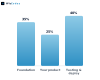
Foundation is the plumbing every product needs. Accounts, logins, permissions, file uploads, payments, an admin view. None of it is what makes your product special, and all of it has to exist.
Your product is the part that is genuinely yours. The workflow nobody else has, the thing your customers are actually paying for. This is usually the smallest slice, which surprises people.
Testing and deployment is making it work reliably for real users, on real devices, under real load. This is the part cheap quotes quietly leave out, and the part you notice first when it is missing.
What makes one project cost more than another?
Four things, in rough order of impact.
How clearly the work is defined. This is the biggest lever by a distance. A vague brief does not just risk building the wrong thing. It forces whoever is quoting to pad the number to cover the uncertainty. You pay for that padding either way.
How many systems it must talk to. Every integration is real work. A payment provider, a CRM, a legacy API someone built in 2014 and nobody documented. Each one adds time that cannot be skipped.
How much is genuinely new. Building a login screen is a solved problem. Building a scheduling engine that handles overlapping shifts across time zones is not. Proven patterns are cheap. Novel logic is not.
How fast you need it. Compressing a timeline usually costs more, not less. Work that could be done once carefully gets done twice quickly.
Why did the arithmetic change?
Modern tooling and AI genuinely lowered the cost of building software. But not in the way most people assume.
They did not make the thinking faster. Deciding what to build, how it should behave, and how the pieces fit together takes the same time it always did. What collapsed is the repetitive part: boilerplate, scaffolding, glue code, first-draft tests, the same login flow written for the tenth time.
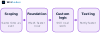
That is a real saving on a real slice of the work. It is not magic, and anyone claiming AI made software ten times cheaper is selling something.
Most companies kept their pre-AI prices anyway. We did not, and that is the entire reason we can charge what we do without cutting quality. It is not that we are cheap. It is that the work genuinely takes fewer hours than it used to.
Why do quotes vary so wildly?
Because they are rarely quoting the same thing.
One quote includes design, testing, deployment, and store submission. Another includes the code and nothing else. On paper the second is half the price. In practice you pay the difference later, usually at a worse moment.
The other reason is the pricing model itself. An hourly rate transfers all the estimating risk to you. If it takes twice as long, you pay twice as much, and the person estimating had no reason to be accurate.
A fixed scope moves that risk to us. We have to estimate well, because a bad estimate is our problem. That is a better incentive for everyone, and it is how we price.
What questions should you ask?
Before comparing any two quotes, ask each of them the same five things.

The ownership question catches more people than any of the others. If the answer is anything other than "you own all of it, on your accounts", that is a cost you have not been shown yet. We wrote about what agency lock-in really costs for that reason.
How do you keep the cost down honestly?
Not by finding a cheaper hourly rate. By reducing the hours.
Define the work before you price it. This is why we build a free prototype first. Pricing something we can both see removes the padding.
Cut scope, not quality. Three workflows done properly beat ten done badly. The three you keep should be the ones your customers actually pay for.
Use proven building blocks. Custom login screens and bespoke admin panels rarely earn their cost. Save the custom work for the part that is genuinely yours.
Sequence around real milestones. Build the smallest thing that proves people want it. Add the rest once you know which parts matter, rather than guessing up front.
Frequently asked questions
How much does custom software cost?
There is no single number, because a quote is hours times a rate plus overhead, and the hours depend on your project. A well-defined product with few integrations costs a fraction of a compliance-heavy platform, even when the screens look similar. The biggest levers are how clearly the work is defined, how many systems it must connect to, and how much is genuinely custom.
Why is one quote half the price of another?
Usually because it includes half the work. Ask both exactly what is covered: design, testing, deployment, store submission, and who owns the accounts at the end. The cheaper quote often excludes testing and deployment, which are the parts you notice most when they are missing.
Is a fixed price better than an hourly rate?
For most projects, yes. An hourly rate puts all the estimating risk on you and gives nobody an incentive to be fast. A fixed scope puts that risk on the people doing the estimating, which is where it belongs. The trade-off is that the scope has to be defined properly first.
Did AI actually make software cheaper?
It made part of it cheaper. The repetitive work, boilerplate, scaffolding, glue code, first-draft tests, genuinely collapsed. The thinking did not: scoping, architecture, and judgement take the same time. So the saving is real but partial, and anyone claiming a tenfold reduction is overselling.
What is the most common hidden cost?
Change fees. A quote that covers only what was specified, on a project where the specification was vague, will produce a stream of extras. That is why defining the work carefully before pricing it saves more money than negotiating the rate ever will.
How much should a first version cost?
Less than you think, if you cut the scope hard. The goal of a first version is to find out whether people want it, not to be complete. Building three core workflows properly and adding the rest later is almost always cheaper than building everything at once.
The short version
The rate is the smallest part of what you pay. The hours are the real cost, and the hours are driven by how clearly the work is defined before anyone starts.
That is why we scope carefully, show you the product before we quote it, and give you one fixed number rather than a meter that keeps running.
Have a project in mind?
Get a free prototype