Custom Support Tooling vs Helpdesk SaaS
Helpdesk platforms encode one model of support work. Here is how to tell whether yours matches it, and which narrow piece is worth building.
Most support software decisions get made on the wrong axis. Teams line up feature grids, pick the one with the most checkmarks, and discover much later that the tool was never the problem — the fit was. The question that actually decides this is narrower than it looks: does your support process match the one your helpdesk assumes, and what happens when it stops matching.
What a helpdesk platform actually assumes
Every off-the-shelf helpdesk encodes a model of support work. A request arrives, it lands in a queue, an agent picks it up, replies, and closes it. Tags and priorities decorate that flow. Automations nudge it along. But the shape underneath is fixed, and it is the shape the product was designed around.
That model is genuinely good for a large share of businesses. If your support looks like inbox triage — questions arrive, humans answer them, occasionally something escalates — a mature platform will do it better than anything you build, because it has absorbed a decade of edge cases you have not met yet.
The friction starts where your process stops looking like triage. A support request that has to check inventory before it can be answered is not a ticket, it is a workflow with a database query in the middle. A request that must be routed by which engineer shipped the feature is not priority sorting, it is a lookup against your own systems. Platforms handle these through extension points: webhooks, custom fields, a marketplace app, a scripting layer. Those work, and they are also where the seams show.
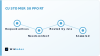
The middle two steps are the interesting ones. A platform can reach your systems, but it reaches them as an outsider: through an API you expose, on a schedule it controls, within limits it sets. Custom tooling starts inside your systems and reaches outward. Neither is better in the abstract. They are different starting positions, and which one suits you depends entirely on where your complexity lives.
The three questions that actually decide it
Feature comparisons are close to useless here, because both options can be made to do almost anything. These three separate them.
How much of your process is standard? Write down the path a request takes from arrival to resolution. Mark every step that any support team would recognise, and every step that only makes sense at your company. If the second list is short, a platform will serve you well and you should not be building anything. If the second list contains the steps that matter most — the ones where mistakes cost you customers — that is where purpose-built tooling earns its place.
Who needs to change it, and how often? This is the question people skip. On a platform, changing behaviour means an admin editing settings, or a developer writing against an extension API and waiting on a release cycle you do not control. With your own tooling, changing behaviour means changing code you own. If your support process is settled, the platform's constraint costs you nothing. If you are still learning what your process should be, that constraint is the whole story.
Where does the data have to live? Ticket history is customer history. It is where your team looks to understand a relationship, and increasingly it is training data for whatever you automate next. On a platform, that history lives in someone else's schema and comes back to you through an export. In your own system it sits next to your accounts, your orders and your product telemetry, and can be queried alongside them.

Notice what is not on that list. Neither column claims to be the responsible choice. A team with an ordinary support process that builds its own helpdesk has taken on maintenance for no gain — every hour spent on ticket routing is an hour not spent on the product. That is a real failure mode and it is more common than the reverse.
Where teams get this wrong
The most common mistake is treating the decision as permanent. It is not. Support tooling is one of the more replaceable parts of a stack, provided you plan for replacement from the beginning. The teams that suffer are the ones who assumed permanence and let the tool become the system of record for things it was never meant to own.
Watch for that drift. It starts when a custom field on a ticket becomes the only place a piece of business state is recorded. Someone adds "refund approved" as a dropdown because it was faster than changing the product. A year on, your finance process depends on a field inside a support tool, and the tool now cannot be replaced without unpicking finance. The tool did not do this. The absence of a boundary did.
The second mistake is building the wrong half. Teams that decide to build often build the whole thing — inbox, threading, agent UI, notifications — and rediscover why mature helpdesks are large products. The version that works is almost always narrower: keep the platform for the parts that are genuinely standard, and build the piece that is genuinely yours. A routing service that decides where a request goes and enriches it with your own context is a small, well-scoped system. A complete helpdesk is not.
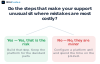
The third mistake is judging the platform by its demo rather than by its extension points. Every helpdesk demos well, because demos show the standard path and the standard path is what platforms are excellent at. The useful evaluation is to take the single most awkward request your team handles and walk it through the tool end to end. Whatever you have to do to make that work — the workaround, the extra app, the manual step — is what you will be doing every day.
What we do about it
Our own bias here is toward building the narrow piece and buying the broad one, and it comes from the work. On AI automation projects the pattern repeats: the valuable custom component is almost never the interface, it is the layer that decides what a request means and where it should go. That layer needs your data, your rules, and the ability to change on your schedule, which is exactly what a platform extension point makes awkward.
That is also why we start engagements with a free working prototype rather than a specification. A document about routing logic is an opinion. A prototype that takes real requests and routes them is a test, and it usually reveals within a session whether the unusual part of your process is genuinely unusual or just unfamiliar. We wrote about why that approach beats a spec in why we build a free prototype first.
If you are weighing this decision, the useful next step is not a feature matrix. It is writing down your own request path and marking the steps that are yours. The answer tends to fall out of that page.
Frequently asked questions
Is custom support tooling only for large teams?
No. Team size matters far less than process shape. A four-person team with a genuinely unusual workflow gets more from a small custom routing layer than a fifty-person team running standard triage.
Can we start on a platform and move later?
Yes, and that is usually the right order. The thing that makes it possible is keeping business state out of the support tool, so ticket history is the only thing you ever have to migrate.
What is the most replaceable part of a support stack?
The agent interface. What is hard to replace is anything that became a system of record — custom fields holding business state, and the historical data your team relies on.
How do we know if our workflow is genuinely unusual?
Walk your most awkward request through a trial of the platform end to end. If handling it needs a workaround, a marketplace app or a manual step, that is your unusual part made visible.
Does owning the code matter for support tooling?
It matters most where the logic encodes something competitive, like how you triage your highest-value accounts. Ownership is covered in more depth in our post on agency lock-in.
What should we build first if we do build?
The routing and enrichment layer — the part that reads a request, attaches context from your own systems, and decides where it goes. It is small, self-contained, and carries most of the value.