FastAPI vs Django for Startups (2026)
FastAPI vs Django for startup products: one handles AI and real-time workloads, the other ships admin panels and mature tooling. Here's how to choose.

FastAPI and Django both power serious products. Only one is built for the AI and real-time workloads most startups need in 2026. Django is the stable choice when you need an admin panel and want years of packages backing every decision. FastAPI is the modern choice when speed, async operations, and tight AI integration matter more than legacy tooling.
What each framework actually offers
Django is a full-stack framework that ships with an ORM, an admin panel, user authentication, and a template engine. You get the database layer, the request router, and the UI scaffolding in one install. It has been in production since 2005 and runs thousands of large-scale systems.
FastAPI is a modern API framework built around type hints and async Python. It generates OpenAPI documentation automatically and handles concurrent requests without blocking. No admin panel. No template system. It assumes you are building an API, not server-rendered pages.
Neither framework is inherently better. Django gives you more out of the box. FastAPI gives you speed and async by default.
What does your product need on day one? A SaaS dashboard with traditional CRUD? Django's admin panel is already built. Real-time AI features or thousands of concurrent API calls? FastAPI's async architecture matters from the start. We walk through the full decision process in our MVP playbook.
Django wins on stability and the admin panel
Django has been in production for nearly two decades. Stable APIs. Solved problems. A vast ecosystem of packages that just work together.
The biggest advantage is the admin panel. It generates a full CRUD interface automatically from your models. Hours or days saved on internal tools.

Django's ORM is also more forgiving for teams without deep SQL knowledge. You define relationships once and the framework handles the queries. FastAPI leaves that to you or to SQLAlchemy, which has more moving parts.
If your product is CRUD-heavy and does not need production LLM integration or real-time features, Django gets you to launch faster. The trade-off is performance ceiling and async complexity when you eventually need them.
FastAPI wins on speed and modern async patterns
FastAPI handles concurrent requests without blocking. Your AI agent streams an LLM response to one user while another uploads a file? Both happen at the same time. Django's traditional request-response cycle waits for each operation to finish before moving to the next one.
Real-time features need this. So does AI automation. Voice AI like CuePilot has to transcribe audio, query an LLM, and send suggestions back while the call is still happening. FastAPI's async design keeps everything moving in parallel.
Modern Python libraries expect async. Most AI SDKs, WebSocket handlers, and streaming APIs ship with async methods first. FastAPI works with them directly. Django requires sync wrappers or background workers, which adds complexity you do not need when shipping an MVP.
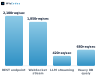
Speed differences show up in three places: response time under load, how many users one server handles, and how much you spend on hosting once you scale past the first few hundred users.
Decision criteria most framework guides skip
Most framework comparisons end at feature lists and benchmarks. Three factors matter more when you are choosing for a startup MVP.
Your team's fluency. If your developer knows Django deeply, that familiarity will ship faster than FastAPI's async advantages. Switching frameworks mid-project is expensive.
Infrastructure reality. FastAPI often needs separate task workers for background jobs. Django includes Celery patterns out of the box. One less service to monitor matters when you are lean.
How much API surface you actually need. Ten CRUD endpoints and an admin panel? Django's batteries-included approach wins. Real-time AI features or WebSocket-heavy interfaces? FastAPI's async foundation becomes essential.

The right framework removes friction from your specific build. Get a free prototype and we will show you which path fits your product before you commit to either.
How to pick the right one for your MVP
Start with your constraints. Not the framework's features. Need the MVP live quickly and your team knows Django? The async advantage of FastAPI won't matter. Building real-time AI voice or streaming responses? Django will fight you at every turn.
Three questions that decide it:
- Do you need a working admin panel on day one? Django ships one. FastAPI does not.
- Will you integrate LLMs, real-time features, or async workflows? FastAPI handles them natively. Django requires third-party layers.
- How much Python experience does your team have? Django's conventions guide juniors. FastAPI assumes you know what you're doing.

We picked FastAPI for CuePilot because real-time voice transcription and live AI suggestions demanded async from the start. For SolarSathi, we used Django because the vendor marketplace needed a working admin panel immediately and real-time features were not in scope.
Pick the one that removes friction from what you are actually building. If the framework makes your core feature harder, pick the other one.
Frequently asked questions
Which framework costs less to build and maintain?
FastAPI usually costs less up front because it needs less code to reach feature parity, and less over time because fewer dependencies need updating. Django's bigger surface area means more maintenance hours.
Can I switch frameworks later if I pick wrong?
Yes, but it means rewriting the backend. Pick for what your product does now and for the direction it is clearly heading, not for a capability you might never need.
Does FastAPI lock me into Python developers who know async?
Somewhat. FastAPI requires engineers comfortable with async patterns, which narrows the hiring pool compared to Django's synchronous model. Plan for that if you're building a team.
How long does it take to build an MVP in each?
For a standard API-backed MVP, Django is faster if you need an admin panel and standard CRUD. FastAPI is faster if you're building real-time features or integrating LLMs.
Which one handles AI workloads better?
FastAPI. It's async-native, so LLM calls and inference pipelines don't block the request thread. Django can do it with Celery, but that adds setup and another moving part.
What happens if my product needs both an admin panel and real-time APIs?
You can run FastAPI for the real-time backend and Django for the admin layer, or add a lightweight admin library to FastAPI. We've done both - it depends on how complex your internal tooling needs to be.