How to Choose an LLM Provider: 3 Boundaries First
Pick your LLM provider by latency, residency, and ownership constraints - not benchmarks. Real product examples show what matters.

An LLM provider is the service that runs the language model behind your product's AI features. The provider controls where inference happens, how fast responses arrive, and whether you can move your integration to a different model without rebuilding your entire stack.
Most teams pick a provider by reading model benchmarks. Then they discover the real constraint later when they need sub-200ms latency, EU-only data residency, or the ability to swap models without rewriting every prompt. Provider choice matters most at the boundaries - the hard requirements your architecture must satisfy regardless of which model performs best on leaderboards this quarter.
What LLM provider choice actually controls
Your provider decision sets three constraints: where inference happens, how fast responses arrive, and who sees your data. Everything else - model quality, prompt design, accuracy - lives in how you integrate, not which API you call.
An LLM provider gives you an inference endpoint that accepts prompts and returns completions. Token throughput and latency characteristics shaped by their infrastructure. A data handling policy that determines residency and retention.
When we built the LLM integration for CuePilot, switching from OpenAI to a self-hosted Llama deployment changed response time and where data lived. Suggestion quality stayed the same. That came from prompt engineering and the context we fed in.
The provider is infrastructure. The intelligence is in your implementation.
Most teams anchor to model benchmarks when the real question is whether your architecture can tolerate cloud inference or requires on-premise hosting. Provider choice matters when compliance, latency, or data residency create a hard boundary. Otherwise, you can reverse it later.
The boundaries that matter: latency, residency, and ownership
Three technical constraints usually decide your provider before you look at the model list.
Latency - how fast the LLM responds - matters when users wait for output. A chatbot that takes four seconds to reply feels broken. A content summarizer that runs overnight does not care.
Data residency and compliance requirements cut your options fast. If you handle EU health records under GDPR, you need a provider with EU-hosted inference or you build self-hosted. API providers in the US do not solve that.

Model ownership and customization separate the next tier. If your product needs fine-tuning on private data or you want control over the inference stack, you host the model yourself or use a provider that supports custom weights. Standard API providers give you prompt engineering and nothing deeper.
We built AI automation services for clients where one of these three boundaries locked the choice before we compared model benchmarks. CuePilot needed sub-second voice transcription, so we ran Whisper locally rather than sending audio to an API. Medical OCR System requirements demanded on-premise inference for data residency.
What it looks like in a real product integration
When we built CuePilot, the real-time voice AI system for customer support teams, provider choice controlled four operational constraints that shaped the entire architecture.
CuePilot transcribes live calls with Whisper and surfaces response suggestions through an LLM. Latency had to stay under 800 milliseconds or agents would talk over the suggestions. All call audio had to stay in US infrastructure for compliance. And the backend needed to handle 50 concurrent calls without manual scaling.
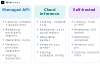
We used OpenAI's API for the LLM layer because the feature required fast iteration on prompt engineering, not infrastructure ownership. For transcription, we self-hosted Whisper on GPU instances in us-east-1. Audio could not leave the region. Latency mattered more than convenience.
Both models worked. Which constraint each part of the system had to satisfy decided the architecture.
Where teams anchor to benchmarks instead of constraints
Most teams start by comparing benchmark leaderboards. MMLU scores, HumanEval pass rates, and arena rankings tell you which model is sharper right now. They do not tell you which provider will work inside your product.
Benchmark performance becomes a proxy for fit. A model with a 92% accuracy score looks better than one with 88%, so the decision feels settled. Then the integration starts. Real constraints show up.
Ask these questions after the benchmark:
- Does your user flow tolerate 800 ms of latency, or does it need under 200?
- Can your compliance framework accept data leaving a specific jurisdiction?
- Will your prompt engineering layer need to retry failed calls, and how does that layer know which provider to fail over to?
A benchmark tells you the model is good. Your architecture tells you whether the provider will work. We see teams reverse the decision order and build around a high-scoring model, then discover they cannot meet latency or residency requirements without rebuilding the integration.
Start with a free prototype that tests the provider against your actual constraints before the architecture hardens around it.
How to tell which provider fits your architecture
Start with where the request travels and what happens at each stop. Path matters more than the marketing page.

Self-hosted inference removes the first three steps. You control the queue, the routing logic, and the model. You also own uptime, scaling, and GPU provisioning.
API providers handle infrastructure but add network hops. Each hop contributes latency. For CuePilot's real-time voice assistant, we needed sub-second response starts. That ruled out providers with cold-start delays or shared queue bottlenecks.
Check these four constraints before picking:
- Latency budget: Can your UX tolerate a two-second wait, or does it break at 500 ms?
- Data residency: Does your compliance framework allow data to cross borders or touch third-party infrastructure?
- Request volume: Will you saturate rate limits during normal use, or only under abuse?
- Control surface: Do you need to tune inference parameters, or is the default output good enough?
Sub-second responses and in-region data requirements mean self-hosted is the only architecture that works. If you can tolerate API latency and your compliance allows it, a managed provider removes operational load.
Frequently asked questions
Does the provider you pick affect what the model can do?
No. The model's capabilities are the same wherever you run it - provider choice controls latency, where the data goes, and whether you manage the servers yourself.
What happens to my data when I send it to an LLM provider?
That depends on the provider's data retention policy and your contract. Some log requests for abuse monitoring, some process and discard immediately, and some let you bring your own infrastructure so data never leaves your network.
Can I switch providers later without rebuilding the product?
Yes, if you code against a provider abstraction from the start. You swap credentials and endpoints, but the prompts, guardrails, and application logic stay the same.
How do I know if I need to own the inference stack?
You need it if regulatory requirements forbid sending data outside your network, if you operate in a jurisdiction where major providers are blocked, or if your product depends on custom models you cannot host anywhere else.
What if the model I picked falls behind on benchmarks next quarter?
Switch models, not providers. Leaderboard position changes constantly - your architecture should make swapping models a configuration change, not a rebuild.
Do all providers support the same response formats and tools?
No. Structured output, function calling, and streaming behavior vary. Check the provider's API documentation for the features your product relies on before you commit.