How Content Recommendation Works (5-Step Pipeline)
How streaming apps decide what you watch next: the pipeline from user behavior to ranked suggestions, with cold-start handling and feedback loops.
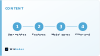
Content recommendation is the system that decides what video, song, or article a user sees next. It looks at what they watched before, what similar users liked, and what is performing well right now. Most streaming platforms score thousands of candidates in real time and surface the top handful.
The recommendation engine owns more of the user experience than any other single feature. It decides retention, session length, and whether users find what they want or bounce.
What content recommendation actually means
Content recommendation decides what shows up next when a viewer finishes an episode or opens the app. It matches viewing behavior data to a catalog and surfaces the titles most likely to keep that person watching.
The term covers three distinct jobs. Personalization shows different content to different users based on what each person has watched, skipped, or rated. Discovery surfaces titles the viewer has never seen, especially new releases or catalog additions they would not find by search alone. Engagement optimization arranges the feed to maximize time spent in the app, measured by play rate and session length.
Most streaming platforms run all three at once. The system logs what you watch, trains a model on that behavior, and uses the model to rank every title in the catalog for your next session. That ranking becomes the order of rows, carousels, and "Because you watched" sections.
The pipeline depends on choosing the right database for user behavior tracking. Recommendation quality breaks down when the data layer cannot keep up with real-time viewing events. A laggy write means stale recommendations. Stale recommendations mean viewers leave to find something on their own.
How recommendation works, step by step
The pipeline starts when a user watches something. The system captures that event - title, duration watched, time of day, device - and logs it.
Next comes feature extraction. What did the user finish? What did they skip? What did they start but abandon? The engine compares those patterns against the catalog and against similar users.
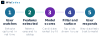
The model scores every candidate in the catalog and ranks them by predicted fit. Top results pass through business rules. Exclude what the user already watched. Surface content the platform wants to promote. Respect regional licensing.
The user sees the recommendations. What they do next - watch, skip, ignore - becomes the next round of training data. That feedback loop is what makes the system learn.
Collaborative filtering clusters users by viewing behavior and suggests what similar clusters watched. For new users with no history - the cold start problem - the system falls back to popularity or category preferences until it has enough data to personalize.
If you need a recommendation engine tuned to your catalog and your user behavior, we build custom AI systems built for your infrastructure.
What it looks like in a real streaming build
In a streaming platform build, the recommendation pipeline has to be something you can change.
Watch what users watch. Track how long they stay and what they skip. Viewing behavior data goes into a collaborative filtering model that runs every night. When a user opens the app the next morning, the feed reflects what the model learned.
You own the model training loop. You decide which signals matter - completion rate, repeat views, shares - and you tune the ranking logic when the feed starts feeling stale. Want to promote a new show? Weight regional content differently? Write that into the business rules and deploy it.

The cold start problem - what to show a brand-new user - gets solved with a short onboarding flow and fallback to trending or editorial picks until the model has something to work with.
Where teams get the model wrong
Most teams assume collaborative filtering means "show what similar users liked" and stop there. That definition misses the part that actually matters: what you compare to decide who counts as similar.
Compare taste on the wrong dimensions and the engine surfaces content people already know. Or recommendations that feel random. Compare the right signals and the model learns what someone wants next before they do.
Another mistake: treating the recommendation pipeline as a machine learning problem when it is a data collection problem first. The model can only learn from signals you capture.
Track watch-time but not where someone stops mid-episode? The engine thinks they loved content they abandoned. Track genre but not mood or pacing? It recommends thrillers when someone wanted background comfort TV.
What decides whether custom fits comes down to whether your catalog and your engagement patterns give standard models enough signal, or whether you need logic tuned to what your users actually do.
How to tell whether you need a custom engine
Most streaming apps can start with an off-the-shelf recommendation service and tune it through API parameters. You need a custom engine when your business logic does not map to a provider's tuning options or when you want full control over the training loop.
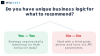
Three signals point toward custom.
Your content catalog has unusual structure. A language-learning platform that groups lessons by grammar concept, not popularity. Or a fitness app that recommends workouts based on recovery windows. These do not fit the collaborative filtering patterns most services expect.
You need to retrain the model daily or hourly. If user behavior changes fast and stale recommendations hurt engagement, waiting for a vendor's batch update cycle costs you users.
You want to own the experimentation loop. A/B testing different personalization strategies, trying new scoring functions, or blending multiple signals requires access to the training pipeline, not just API knobs.
If your logic fits a provider's parameters and you can tolerate their update cadence, start there. You can always move to custom later once you have validated what drives your engagement patterns.
Frequently asked questions
Does a custom recommendation engine see what users actually watch, or just what they click?
It sees both - play events, watch duration, skips, replays, and anything else you log. Click data alone misses whether someone finished what they started.
What happens to the recommendation model when you add a new content category?
The model retrains on the expanded catalog. If your feature set includes category embeddings, it adapts automatically; if not, you add the feature and retrain.
Can a recommendation system work if most users are new and have no watch history?
Yes, through content-based filtering - the engine recommends based on what the item is, not what other users liked. Collaborative filtering needs history; content-based filtering does not.
How do you stop a recommendation engine from only showing popular content?
You add an exploration term to the ranking function that injects less-popular items, then measure whether engagement stays stable. Pure popularity ranking creates a feedback loop.
What breaks first when a recommendation system scales to millions of users?
The inference step - computing scores for every user-item pair in real time. You fix it by precomputing candidate lists, caching results, and sampling instead of exhaustive ranking.
Does the recommendation model need to know why a user stopped watching something?
It helps but is not required. Explicit signals like 'not interested' or 'dislike' let the model learn faster than inferring intent from watch duration alone.