PRODUCT
Cyber Agent
We were running the same ten security tools by hand on every audit, so we built something to run them for us.
- Our role
- Product · Backend · AI pipeline · Frontend
- Platforms
- Web
- Python
- FastAPI
- LangGraph
- Claude API
- Resend
- 10scanners in parallelOne pass instead of ten sequential runs
- AIseverity rankingFindings ordered by business impact, not tool output order
- PDFreport, generatedWritten and formatted without a human editing pass
- Scheduledor on demandRe-scan on a cadence, or trigger a one-off
At a glance
- Business problem
- A thorough website security assessment means running roughly ten separate tools, reading ten separate outputs, and writing the findings up by hand. WizCodes was doing that manually on every audit, and most of the effort was collation rather than analysis.
- Technical challenges
- Cyber Agent has to run many scanners concurrently without them interfering, normalise ten incompatible output formats into one finding shape, decide which findings actually matter, and produce a report a non-technical reader can act on.
- Engineering solution
- Cyber Agent runs its scanners in parallel behind an orchestrator, normalises every result into a single finding schema, has an LLM rank findings by business impact rather than by raw tool severity, and generates the written report from the ranked set.
- Core features
- Parallel scanning across ten security tools. Normalised findings from incompatible tool outputs. AI ranking by business impact rather than raw severity. Generated PDF report, written for a non-technical reader. Scheduled re-scans and on-demand runs. Dashboard for reviewing findings across scans.
- Architecture
- Scan OrchestratorSecurity ToolsAI AnalysisReport GeneratorDashboard
- Technical highlights
- Scanners run concurrently, so total time is the slowest tool rather than the sum. One normalised finding schema behind ten incompatible tool outputs. LangGraph holds the orchestration state, so a failed scanner degrades the run instead of ending it. The report is generated from ranked findings, not from raw scanner output.
- Business value
- Cyber Agent turns a day of tool-wrangling and write-up into a single scan and a finished report. The engineering time goes into interpreting findings rather than into collecting them.
Why we built this
Security review is part of how we hand a project over. Before a site goes to a client we check the TLS setup, the headers, the cookies, the exposed paths, the dependency versions — the ordinary list.
Doing that properly means running about ten tools. Each has its own flags, its own output format, and its own idea of what counts as severe. So the work splits into two very different halves: a few minutes of running things, and a few hours of reading ten reports, working out which findings overlap, deciding which ones a client should actually care about, and writing it all up in language they can act on.
The second half is where all the time went. It is also the half that is almost entirely mechanical.
Nobody asked us for this. We built it because we kept doing the same afternoon over and over.
The constraints
These were our own decisions, not requirements handed to us — which changes what "constraint" means here. Nobody set a deadline, so the constraints are the ones we chose to accept.
Ten tools, kept as-is. We could have written our own scanners and controlled the output format. We decided not to: the existing tools are better than anything we would write, and maintaining our own would become the whole project. So the tool outputs are a fixed, messy input we do not get to change.
A report a non-technical reader can act on. The output had to be something a client reads and understands, not a findings dump. That is a much harder target than a machine-readable list, and it is the reason there is an AI layer at all.
Degrade, never fail. One scanner erroring should cost that scanner's findings, not the run. We chose this early because the alternative — an all-or-nothing scan — would have made the tool useless exactly when a site is unusual, which is when a scan matters most.
The genuinely hard part was never running the tools. It was deciding which of forty findings a business owner should read first.
How we built it
An orchestrator fans the scanners out concurrently, so total time is the slowest tool rather than the sum of all ten. Each result is normalised into one finding shape — severity, location, description, evidence — which is what makes the ten incompatible outputs comparable at all.
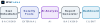
The AI layer sits after normalisation and does one job: rank. Raw scanner severity is not business impact — a tool will mark a missing header "high" and an exposed admin path "medium" because it is scoring the class of issue, not the situation. The model ranks the normalised set against what the site actually is, and the report is generated from the ranked order.
LangGraph holds the orchestration state, which is what makes the degrade-never-fail rule cheap to implement rather than a pile of error handling.
Inside the product
- Ten tools, one runEach scanner reports its own state. The value is not any single tool — it is that all ten finish without anyone sequencing them by hand.
- Severity before detailThe counts answer the only question asked first: how bad is this. Everything below them is for the second question.
- Ranked, not chronologicalFindings are ordered by business impact, not by which tool happened to return first. That reordering is the product, and it is invisible unless you have seen the raw output.
- A draft, not a deliverableThe report is generated to remove the collation work. We read every one before it goes anywhere.
The dashboard shows the scan while it happens: which scanners have finished, which are still running, and the findings appearing as they normalise.
The counts at the top are the summary a reader wants first — how bad is this, roughly. Underneath, findings are listed in ranked order, not in the order the tools happened to return them. That reordering is the single most valuable thing the tool does and it is completely invisible unless you know the raw output.
The report at the bottom is generated, not templated. It is a first draft that removes the collation work — we still read every one before it goes anywhere. An AI-written security report that nobody checks is a liability, not a product.
What we built
- An orchestrator running ten security tools concurrently
- One normalised finding schema behind ten incompatible tool outputs
- An AI ranking layer that orders findings by business impact
- Generated PDF reports written for a non-technical reader
- Scheduled re-scans and on-demand runs
- A dashboard for reviewing findings across scans
The decisions that mattered
Orchestrate existing tools rather than write our own. Writing scanners is a tarpit — they need constant maintenance as the threat surface moves, and ours would always be worse than the maintained ones. Treating the tools as fixed, messy inputs was the decision that kept the project small enough to finish.
Rank with a model, not with a rules table. We tried a scoring table first. It worked until it met a site that did not match its assumptions, and then it confidently sorted the wrong thing to the top. Ranking needs context about what the site is, which is what a model is actually good at.
Normalise before analysing, not after. Tempting to hand the model ten raw outputs and let it work it out. That makes every run a different shape, makes the ranking unreproducible, and spends a lot of tokens on parsing. Normalising first means the model only does the judgement work.
Degrade over fail. A partial scan with nine tools' findings is useful. A failed scan is not. This decision cost more error handling than it looks like, and it is the one we would keep first.
The agent pipeline behind this is open source. If you want the build rather than the story — the two LangGraph state graphs, the eight agents and which model runs each one, the infrastructure that keeps a long multi-agent run alive — that is on the Cyber Bug Bounty Agent page.
We use this on our own assessments. If you want a security review of something you have built, tell us what it is — or read how we think about automating the repetitive parts of a business, which is the same instinct that produced this. The AI automation work we do for clients uses the same orchestration approach.
Questions buyers ask
Why build this instead of buying a scanner?
Commercial scanners are good at finding issues and poor at deciding which ones matter to a particular business. The ranking layer and the written report were the parts we kept doing by hand, so those are the parts worth building.
Does an AI-written security report need a human review?
Yes. The report is a first draft that removes the collation work, not a substitute for someone who understands the client's risk. We read every report before it goes anywhere.
Can you run a security assessment on our site?
Yes — security review is part of how we build, and we do standalone assessments too. Get in touch and we will tell you what we would look at and what it would cost.
Is this available to use directly?
Not yet. Cyber Agent is in development and we use it internally on our own assessments. If you want to know when that changes, tell us and we will let you know.